Bryan Johnson spent millions to reverse aging. Then his own stomach started digesting itself.

Bryan Johnson, the 48-year-old tech founder who turned his body into a full-time longevity experiment, has been diagnosed with autoimmune gastritis (AIG) — an incurable chronic condition in which the immune system attacks the stomach lining and impairs nutrient absorption. The diagnosis arrived after roughly 11 years of persistently low serum ferritin that his extensive monitoring apparatus had never explained.
Johnson had spent years running “Project Blueprint”: a reported $2 million a year, a 30-person medical team, 111 daily pills at peak, plasma transfusions from his teenage son, stem cell injections into six joints, and a gene therapy performed in Honduras that had not been approved by the FDA. He called himself “the most biologically measured man in the world.” Yet the condition that finally forced a reckoning had been building inside him for over a decade, invisible to the very dashboard he had built to catch it.
In response, Johnson announced a new iPSC “Baby Bryan” project — reprogramming his adult cells back to a pluripotent state. He conceded that no independent lab had yet verified the “age zero” claim, and that the DNA mutations accumulated over 48 years were still there. The episode is not a story about one man’s failure. It is a story about an industry that has turned “reversing aging” into a $30 billion-plus market — and about what gets sold when the metrics look good but the biology does not.
An ordinary professor lowered his biological age by nearly 15 years in 8 months. The protocol was boring.
没有基因治疗,没有年轻血浆,没有未获批的洪都拉斯诊所。新加坡国立大学教授 Dean Ho 拿自己做了唯一受试者:每天在 4 小时窗口内进食,力量训练,有氧运动,晚上 9:30 上床。8 个月后,AI 估算他的生物年龄约 32 岁,比实际年龄年轻近 15 岁。他的静息心率从 65 降到 46,代谢切换速度从 24 小时缩短到 16.5 小时。这项 N=1 研究发表在《PLOS One》上,作者本人明确警告:他的方案非常严苛,普通人不应盲目照搬。但方向是清晰的——目前人体证据最强的长寿干预,恰好也是最便宜的那一类。
What he actually did
每天约 20 小时禁食(上午 11 点至下午 3 点进食),穿插多次 48 小时完全断食;地中海饮食为主(绿叶菜、浆果、橄榄油、优质蛋白);每天早晨力量训练,每次练一个核心肌群,每周 3 次 40 分钟有氧;晚上 9:30 至次日 5:30 睡眠,睡前减少屏幕、室温 21–22°C。
What the evidence says for the rest of us
2026 年 8 月,耶鲁大学团队在《Nature Medicine》汇总了 51 项干预研究、110 余项 DNA 甲基化标志物,结论是:药物干预(二甲双胍、司美格鲁肽、抗 TNF 疗法)和生活方式干预(饮食 + 运动)能可量化地降低表观遗传年龄,而非处方补充剂没有显示出可量化的影响。换句话说,最容易被营销的东西,恰恰是证据最弱的那一类。

Ponce de León and the Fountain of Youth: a myth that outlived the man who searched for it
In 1513, Spanish explorer Juan Ponce de León sailed from Puerto Rico in search of a legendary spring whose waters could restore youth. He never found it. He returned to Florida in 1521 to continue the search and was killed by an Indigenous arrow. The historical irony is that Ponce de León almost certainly never actually searched for the Fountain of Youth — the association was attached to his name decades later by chroniclers who needed a moralizing parable about vanity and ambition. The myth has proved far more durable than the man. It survives in every “fountain” product, every “age-reversal” clinic, and every pitch deck that promises to find the source of youth somewhere beyond the horizon.

Diane de Poitiers drank gold every day to stay young. The autopsy took 450 years.
Diane de Poitiers, the mistress of King Henry II of France, was legendary for her ageless appearance. A courtier who met her six months before her death at 66 wrote that “if this lady had lived another hundred years she would not have aged”. What he did not know: she was drinking a daily tonic of gold chloride mixed with diethyl ether. In 2008, forensic analysis of her remains found extremely high gold concentrations in her hair; researchers concluded she likely died of chronic gold intoxication. The logic behind the practice was elegantly stupid: gold does not corrode, therefore drinking gold must confer incorruptibility. It is the same categorical error — mistaking a physical property for a biological one — that reappears every time someone sells a “preservative” as a cure.

The Count of St. Germain: the “man who never dies” who left behind a 500-year paper trail
The Count of St. Germain was a real 18th-century adventurer, alchemist, and confidant of Casanova, Voltaire, and Mozart. He claimed to be 500 years old and to have known ancient Egyptian masters; Voltaire called him “the Wonderman” and “a man who does not die, and who knows everything”. He dazzled courts with alchemical feats — removing flaws from diamonds, producing gold, and reportedly possessing an elixir of youth. The half-truth is that St. Germain certainly existed and certainly cultivated the myth. The invention is everything else: his origins, his age, his elixir, and the claim that he was later seen at the signing of the U.S. Constitution. He is the archetype of the longevity guru who sells not a product but an *aura* — and who is careful never to leave a verifiable date of birth.
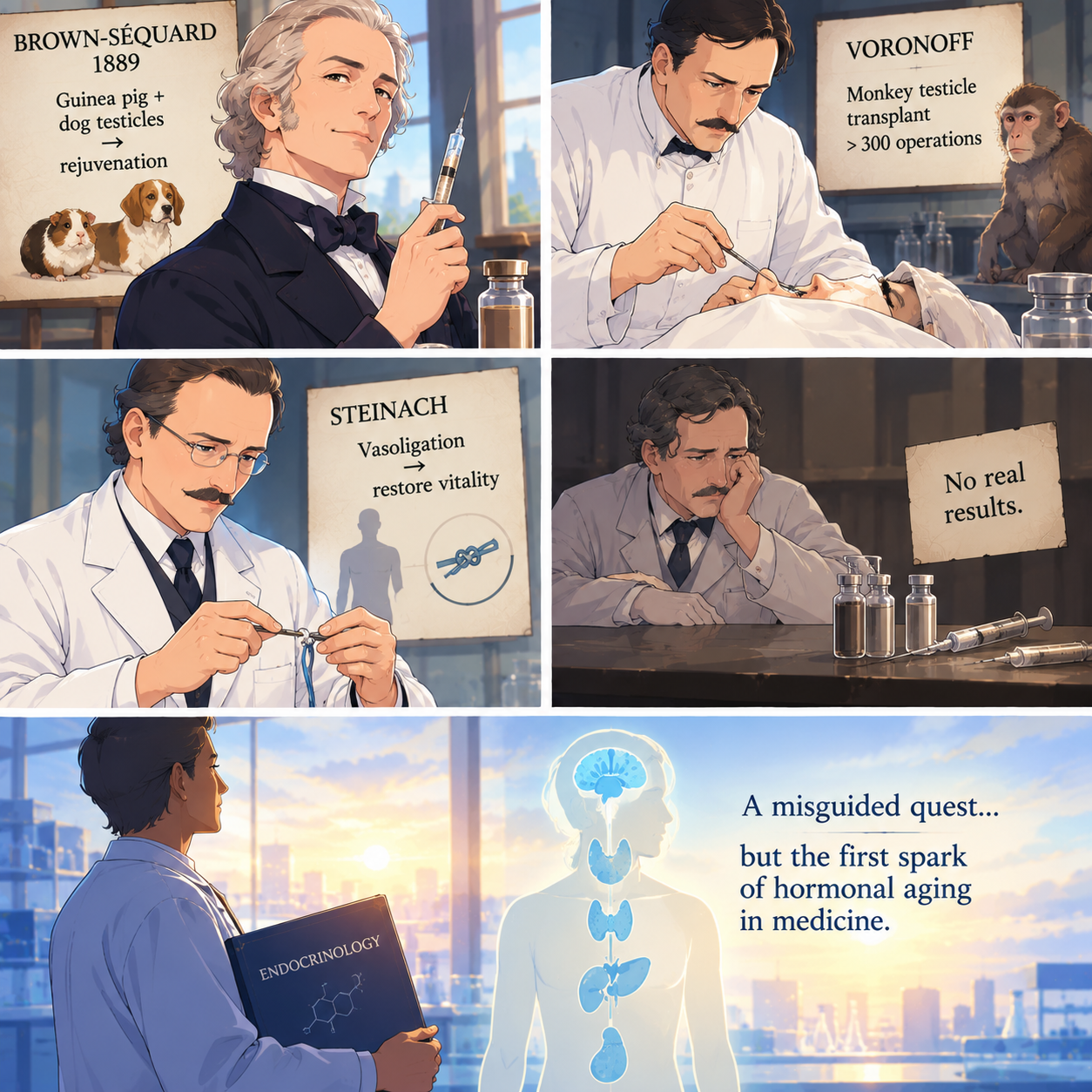
The doctors who injected themselves with animal testicles and grafted monkey glands into their patients
In 1889, the French-American physician Charles-Édouard Brown-Séquard, then 72, injected himself with an extract made from guinea pig and dog testicles and announced to the world that he felt rejuvenated. The claim triggered a global craze. The Russian surgeon Serge Voronoff went further, transplanting slices of monkey testicle into human patients; more than 300 such operations were performed. The Viennese physiologist Eugen Steinach promoted vasoligation — tying off the vas deferens — as a way to redirect sperm back into the body and restore vitality. None of it worked. But the episode was not purely foolish: it was the first time the idea of *hormonal* aging entered mainstream medicine, and it paved the way for endocrinology. The line between crank and pioneer is often drawn only after the fact.

James Bedford became the first human ever frozen. He is still waiting.
On January 12, 1967, Dr. James Hiram Bedford, a 73-year-old retired psychology professor dying of kidney and lung cancer, became the first person to be cryonically suspended. He was placed in a dewar of liquid nitrogen at −196°C. Over the following decades, his body was moved repeatedly — from Arizona to California, then back to Arizona — as storage costs mounted and relatives fought legal battles to have him thawed and buried. When Alcor examined his dewar in 1991, he was described as “a well-developed, well nourished male who appears younger than his 73 years”. Bedford remains in cryonic suspension today, along with roughly 250 others in the United States. The open question is not whether he will wake up. It is whether the *idea* of buying an option on the future — rather than changing the present — will remain the dominant metaphor for how the wealthy confront death.
The “Venus Project”: Epstein did pay for genetic testing. That is where the evidence ends.
Newly released emails and invoices confirm that Epstein paid a Harvard-affiliated physician-researcher, Joseph Thakuria, for genomic sequencing, and that the two discussed a proposal to use CRISPR gene editing on Epstein’s own stem cells to introduce mutations “believed to increase longevity”. A document titled “Venus Project” lists costs of roughly $193,400, including $100,000 for genomic hardware and $1,000 per exome for 200 participants. This is the part that is actually in the files.
The exaggeration begins immediately after. Thakuria told CNN that Epstein was simply enrolled in the Personal Genome Project, that a $2,000 check covered DNA sequencing, and that the funding discussions for broader research “never materialized”. There is no evidence of a secret island laboratory, no evidence of a completed CRISPR experiment, and no evidence that any longevity treatment was ever delivered. What the files show is a wealthy man exploring a speculative biomedical idea — not a functioning anti-aging facility.
Adrenochrome and the “fear hormone” harvest: the most viral rumor, and the least scientific
The most widely circulated claim is that children were terrorized on Epstein’s island so that their bodies would produce adrenochrome, a compound formed by the oxidation of adrenaline, which was then harvested and injected into elites to “reverse aging”. A related version claims that the stress of fear produces a special “repair hormone” that explains why Stephen Hawking, who had ALS, lived to 76. These claims spread through QAnon-adjacent networks and were amplified after the 2026 document release.
The scientific problem is straightforward: adrenochrome has no established anti-aging function in humans. It is a lab-oxidizable derivative of adrenaline, not a scarce rejuvenation compound, and there is no credible research supporting the claim that it can be harvested from terrified children and used to extend life. Fact-checking of the released files found that the term “adrenochrome” appears in only a single document, and that the blood-harvesting narrative has no basis in verifiable science. The Hawking “repair hormone” claim is even more tenuous: Hawking’s longevity with ALS is remarkable but is not evidence of an exotic treatment, and the official record of his 2006 visit describes a scientific conference, with no allegation of involvement in abuse.
Placental stem-cell harvesting and “MedBed” regeneration technology: the rumors that were checked and failed
A parallel set of rumors claims that girls on the island were forced to become pregnant so that placental and umbilical-cord stem cells could be extracted for elite longevity treatments. These claims often cite Epstein’s associate Peter Nygard, who reportedly spoke about the value of placental stem cells. In the Chinese-language information sphere, versions of this story circulated widely in late 2025 and early 2026.
A more extreme variant claims that the DOJ files contain a document labeled “PROJECT MEDBIRTH” describing “Medical regeneration technology” and “MedBeds” — miracle devices kept secret from the public. This specific claim was fact-checked and found to be false: the document ID “DOJ-2024-EF-7721” does not exist in the DOJ library, and searches for “PROJECT MEDBIRTH”, “MedBeds”, and “Medical regeneration technology” return zero matches across the released files. The placental stem-cell story, while less directly falsifiable in every detail, remains at the level of rumor and inference, with no documentary confirmation that such a procedure was performed on the island.
Why include rumors at all? Because the desire for a hidden cure is itself part of the longevity story.
These rumors circulate because they satisfy a structural demand. If the rich appear to age more slowly, the conspiracy theory offers a morally satisfying explanation: they must be harvesting something from someone. It converts an uncomfortable but banal truth — that wealth buys better food, safer environments, more leisure time, and superior medical surveillance — into a secret crime. The irony is that the actual longevity advantage of the wealthy is largely boring and legal: better prevention, better adherence, less chronic stress, and access to the unglamorous determinants of health. The rumor is more exciting than the reality. That is precisely why it spreads.
The Epstein files contain real evidence of terrible crimes. They do not contain evidence of a working longevity technology. Confusing the two does not expose power; it protects it, by substituting fantasy for the harder work of accountability.

Metabolic intervention: mTOR and AMPK — aging as a nutrient-sensing byproduct
Human trials ongoingThis is the route with the thickest evidence base. Rapamycin (an mTOR inhibitor) extends lifespan in mice by roughly 10–25%, and has been called “the most resilient, reproducible, and robust anti-aging target” in the field. In 2026, UT Health San Antonio launched a randomized, placebo-controlled trial of approximately 84 older adults to assess short- and long-term effects of rapamycin on healthy aging. The TAME trial with metformin received FDA recognition of a composite “age-related disease cluster” endpoint years ago, but has still not enrolled a single patient — stuck in the structural trap of a cheap generic that no company will fund. Rapamycin’s own human data remain mixed: a Phase 3 trial is evaluating immune resilience in older adults, but no RCT has yet proven a longevity benefit in healthy humans.

Senolytics: kill the “zombie cells” and let the tissue repair itself
Positive human signals, but disease-specificSenescent cells stop dividing but keep secreting inflammatory factors that poison surrounding tissue. Senolytics selectively clear them. A 2026 systematic review of human clinical trials found that dasatinib plus quercetin showed preliminary improvements in selected functional outcomes and reductions in senescence-associated biomarkers, while senomorphic and mTOR-targeting interventions showed effects on selected tissue and immune-related outcomes. Fisetin, a naturally occurring flavonoid, has shown anti-inflammatory, antioxidant, and senolytic properties in preclinical work, but completed human trials are heterogeneous: some report favorable metabolic or inflammatory changes, others find no clear clinical benefit. A 2026 trial of the PAI-1 inhibitor TM5614 in older adults reported an average 2–3-year reduction in biological age alongside immune and regenerative improvements. The honest framing remains: senolytics have demonstrated mechanistic validation in age-related disease, not lifespan extension in healthy people.
Epigenetic reprogramming: change how cells read DNA, not the DNA itself
First-in-human, preliminary signalsThis is the peak of current scientific imagination — and the peak of controversy. Life Biosciences, co-founded by David Sinclair, developed ER-100, a gene therapy that delivers partial Yamanaka factors (OSK) to push cells’ epigenetic state backward without fully reverting them to a stem-cell state. In June 2026, ER-100 became the first therapy built to reverse cellular aging to be tested in humans, with the first patient dosed in a Phase 1 trial for optic neuropathies including glaucoma. Data presented in October 2026 showed that 2 of 3 patients improved on the Humphrey visual field test. Sinclair has publicly suggested the first person to live to 150 may already be born. The caution is equally loud: three patients, no independent replication, and a deeper unresolved question — does a lower epigenetic “age reading” actually correspond to functional rejuvenation?

NAD⁺ supplementation: the biomarker goes up, the clinical endpoint does not follow
Mixed evidenceNAD⁺ declines with age, and oral NR, NMN, and NAM reliably raise circulating NAD-related metabolites in humans. A 24-week randomized, double-blind, placebo-controlled trial of high-dose NMN in older adults published in Nature in 2026 confirmed sustained NAD⁺ augmentation — but found no significant improvement in the primary endpoint of auditory function or in physical performance measures. A systematic review reached the same conclusion: “Oral NR/NMN/NAM reliably raise NAD-related biomarkers in humans. Human effects on metabolic, vascular, and performance outcomes are mixed”. The route is pharmacokinetically clear and clinically open. That distinction is precisely what the supplement market blurs most aggressively.

Stem cells, torpor, and hibernation: from “replacing parts” to “slowing the clock”
Preclinical / early explorationThe stem-cell route attempts to directly replenish or replace depleted cell populations. The hibernation route offers a completely different metaphor. In 2026, researchers identified Samd3-positive neurons in the hypothalamic preoptic area of Syrian hamsters — the first defined population of specific neurons capable of “switching on” a deep torpor-like state. Hibernating animals themselves show longer lifespans and stronger resistance to aging than closely related non-hibernating species. The scientific distance between “inducing a torpor-like state in a hamster” and “safely slowing a human’s biological clock for years” is not a technical detail — it is an entire physiological paradigm. Cryonics preserves a person in the hope that future technology will arrive; torpor research tries to actively slow the clock now. They share a vocabulary of cold, but they are separated by an order of magnitude in scientific maturity.
Editor's note: the accessibility problem is harder than the biology problem
The most uncomfortable pattern in the 2026 longevity landscape is that the most aggressive interventions cluster almost entirely among those who can pay for them. Bryan Johnson’s $2 million-a-year protocol, the unapproved gene therapy in Honduras, the private stem-cell injections — their common denominator is not science. It is access. They are, first, a wealth-sorting mechanism, and only second, a biological hypothesis.
At the other end, the interventions with the strongest human outcome evidence — cardiorespiratory fitness, muscle strength, diet quality, sleep, smoking cessation, metabolic risk management, social connection — are precisely the ones that do not distribute by ability to pay. The 2026 systematic reviews keep saying the same thing in different words: in human longevity, the strongest evidence is not in rapamycin or NAD⁺. It is in the unglamorous variables that cannot be packaged as a “breakthrough.” Dean Ho’s N=1 experiment is interesting not because it is rigorous — it is not — but because it is the rare longevity story where the intervention is visible, affordable, and testable by ordinary people.
This is why the contrast between cryonics and hibernation research matters more than it first appears. Cryonics outsources hope entirely to the future; it is, at bottom, a financial product — pay now, receive a possible option on being thawed and repaired later. Hibernation research attempts something almost opposite: to find a controllable physiological state in the present that lets the biological clock run slower, lets damage accumulate less, so that waiting does not require total shutdown. The first escapes time. The second renegotiates the terms. The second is far less mature, but at least it is pointed in an honest direction.
And this is also why the Epstein longevity rumors, for all their darkness, are worth naming as rumors rather than repeating as revelations. They offer a hidden-mechanism explanation for an inequality that is, in reality, painfully visible and boringly legal. The wealthy do not need a secret island harvest to live longer. They need exactly what the evidence already shows: better prevention, less stress, more time, and superior medical attention. The conspiracy is more exciting. The truth is harder to fix.
If there is a genuine breakthrough in 2026, it may not be a molecule or a pathway. It may be a slowly consolidating consensus: the goal of longevity is not to live longer, but to live longer without losing function. Compress the period of illness, not extend the period of dependence. By that standard, the gap between Johnson’s 111 pills and the 11 years he went without a colonoscopy is more instructive than any mouse study published this year.